
Whose support has Labour been losing?
Welcome to the 203rd edition of The Week in Polls (TWIP), taking a look at a new and detailed study on who has switched away from Labour and why.
This is followed by a summary of the latest national voting intentions polls, seat projections from MRPs, and the most recent party leader ratings.
Subscribers who pay for the full edition can also read ten insights from the latest polling and analysis, including:
Which parties people would most want to vote against;
A big change in people’s views on tax and spending; and
What three focus groups tell us about why people voted the way they did in the Gorton and Denton by-election.
If you are not yet a paid subscriber, you can read all ten by starting a free trial now:
For more polling news as it comes in during the week, you can also follow The Week in Polls on Bluesky.
One other preliminary: I have recently switched to using the online Keeper password manager, which makes it convenient to have secure and unique passwords for all your online logins - while also making it easy to then use them. You can get a free trial and then 30% off your first year with this affiliate link.
And with that, on with the show.
A new analysis of Labour’s lost supporters
I’m not sure who said, “Public opinion is for the government what a topographical map is for an army command in time of war”. I’ve seen it attributed to Count Alexander von Benckendorff though even if that is right, it still leaves open the question of which Count by that name it was: the Russian ambassador to the UK or the cavalry general?
But I do like it as a phrase. It makes the point about how important it is to understand public opinion, but also that doing so sets a landscape to be navigated, helping you work out the best route to take to achieve your objectives, rather than being something that sets the objectives themselves.
For Labour, a big question about the political map in front of them is how much to worry about losing support to populist parties and the right versus worrying about losing support to the left, liberal parties or apathy. Get that bit of map reading wrong and you head off in completely the wrong direction.
I covered last summer how, on balance, the evidence from opinion polls points to the latter being the bigger problem for Labour, even though the Labour strategy has been to worry much more about the former. Plenty of other evidence has appeared since adding to this picture.
So too has the ‘negative evidence’ of those making the case for Labour’s strategy being mostly silent about rather than challenging such evidence. There are some very smart polling and data people in Labour circles. So the absence of public arguments from them that deploy data to make a case for focusing on Reform suggests that perhaps such arguments cannot readily be made.
(Just as I was writing this Chris Curtis, pollster turned Labour MP, has a new piece about Labour’s hero voters. It deploys evidence well and defends the ‘hero voters’ approach but notably concludes, too, that “Labour is losing votes on both its right and left flanks” rather than seeking to defend an approach of concentrating on just the former.)
We now also have new evidence from Steve Akehurst, in conjunction with Persuasion and 38 Degrees. As Steve writes:
Most pollsters will now show you Labour losing more to the left than right.
These are not, despite what some say, ‘metro libs’ in safe seats - they’re spread out in electoral battlegrounds all over the country. Labour’s 2024 victory was partly built on them, especially in the Blue Wall.
Furthermore, the ceiling on total defections to the left is MUCH higher - because of the way the sociology of the Labour vote has changed over time.
You cannot over-correct and be too complacent about Labour/Reform switchers - they matter too. But Labour need both left and right to win.
One detail he pulls out is that, as my piece showed last year, there are significant differences between pollsters in the picture they paint of how much support Labour is losing to the right/populists versus the left/liberals:

From this, I think it is fair to conclude that Labour’s problem is more with left/liberal defectors than right/populist ones, but note that, given their differences, some pollsters must be getting the picture wrong. Note too therefore a limitation of simply averaging pollsters together: when pollsters are telling different stories, it may well be that the truth is some stories are right and some wrong rather than the truth sitting somewhere on average between them all.
As to who these defectors are, the analysis says:
Progressive defectors cannot be dismissed as ‘professional middle class’ urbanites. They are better understood as frustrated lower middle class graduates. They over-index on doing jobs like teachers, clerical and secretarial workers, and IT professionals. This is especially true of Labour to Green voters.
They are disproportionately found in the South East of England but outside London. They are likely to be particularly populous in ‘Blue Wall’ seats Labour won across the South of England from the Conservatives, many for the first time…
While defectors from Labour generally are divided on ‘culture war’ topics like immigration, both at a level of values and salience, they are generally united on economics.
When progressive defectors think about what’s gone wrong with the country, they tend to blame Brexit as the starting point - while right defectors reach for migration.
However, that is not to say that general competence and improving the economy is necessarily what will win them back, because:
Progressive defectors are more likely to have left Labour over ideological differences on one or two specific issues. Right defectors it tends to be more an issue of overall competence.
Only 17% of these defectors recognise that Labour has increased spending and investment - in fact over a third of them think the government is cutting spending.
An impatience for change and a desire for government to move faster unites left and right defectors from Labour.
It is more a question of yes, getting it right on the basics of the economy and competence matter - but so does avoiding the sort of signature moves that antagonise the left/liberal defectors.
As for the hope that an anti-Reform tactical voting appeal might work to win back left/liberal defectors:
The party shouldn’t assume these voters will automatically return solely on the strength of the threat of Reform. While they do in crude squeeze scenarios, in more realistic information environments, far fewer do.
If tactical voting appeals may be of limited success for Labour, what about particular policy ideas? The research tells us about that too with the most successful being these:
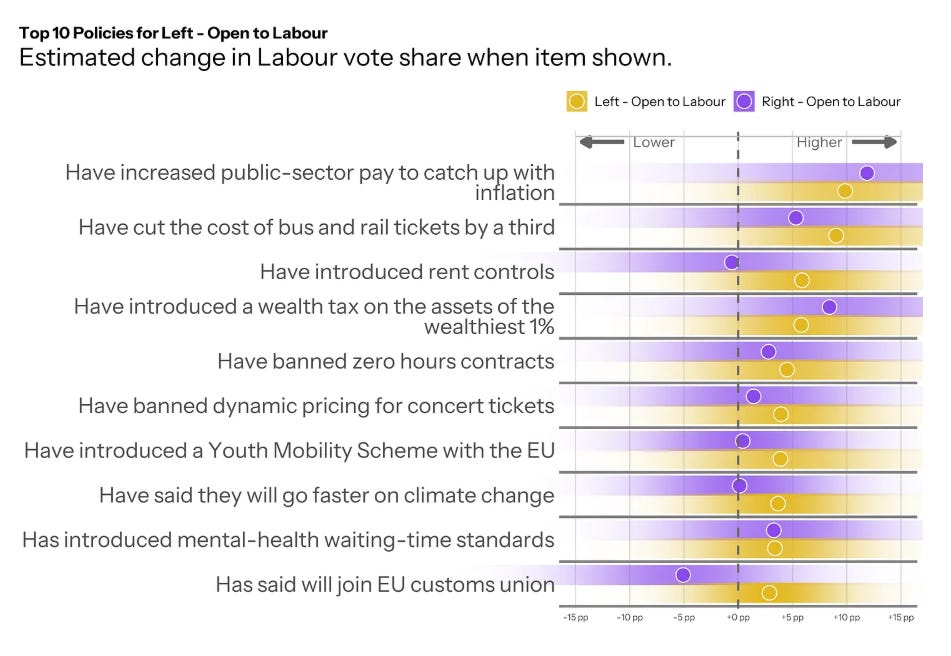
Although some issues are polarising, it’s notable how many appeal across the political spectrum. Of course, the overall impact of a package of policies is not simply the sum of each policy, but rather the overall story that the package tells. Yet that reinforces the conclusion from eyeballing the individual policies in that graph: for all the talk about British politics being polarised, there may be scope for a unifying message that works - to varying degrees - across the board.
More (much more) on Steve Akehurst’s own Substack.
Elsewhere from me…
A very widespread - and powerful - critique of policy-making in Whitehall is that it is horribly short-termist, too often driven by a desire to find a new announcement to slot into a media grid or ministerial speech.
Which is one of the reasons why I have found my time on the Secondary Legislation Scrutiny Committee (SLSC) in the House of Lords so puzzling. It gives a close-up view of how slowly so much of secondary legislation moves. Yet that slowness even applies when all those flaws mentioned above would lead you to expect Whitehall and ministers to be trigger-happy about rushing something through.
There is a great (or is that awful?) example of this currently going through Parliament:

If you spot a factual error…
Borrowing an idea from Stuart Ritchie and others, if you spot a factual error in an edition of this newsletter, I will give you a free 12-month subscription to the paid-for version (or an extra 12 months on your existing one). Factual errors qualify rather than grammatical errors or disagreements over interpretation, with my decision being final. Messages about both of those are always very welcome, though.
Voting intentions and leadership ratings
Here are the latest voting intention polls from different pollsters, with a modest bump (varying between +1 and +4) for the Greens following the win in the Gorton and Denton by-election. By-election bumps have sometimes been short-lived, so next week’s polls will be worth watching closely to see whether or not that looks to be the case this time.
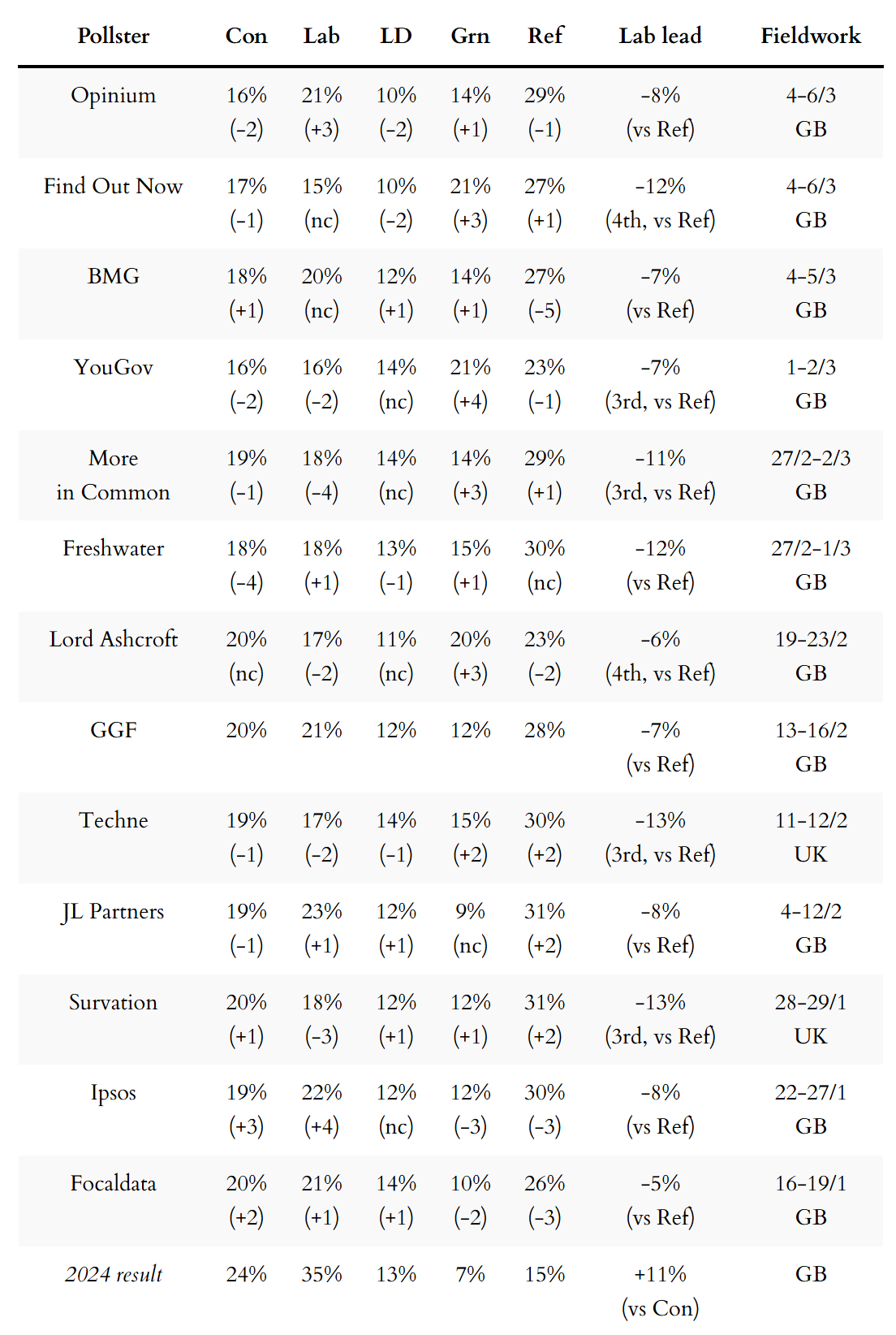
The table is also online here, along with explanations about what is included. It is updated regularly through the week with new polls.
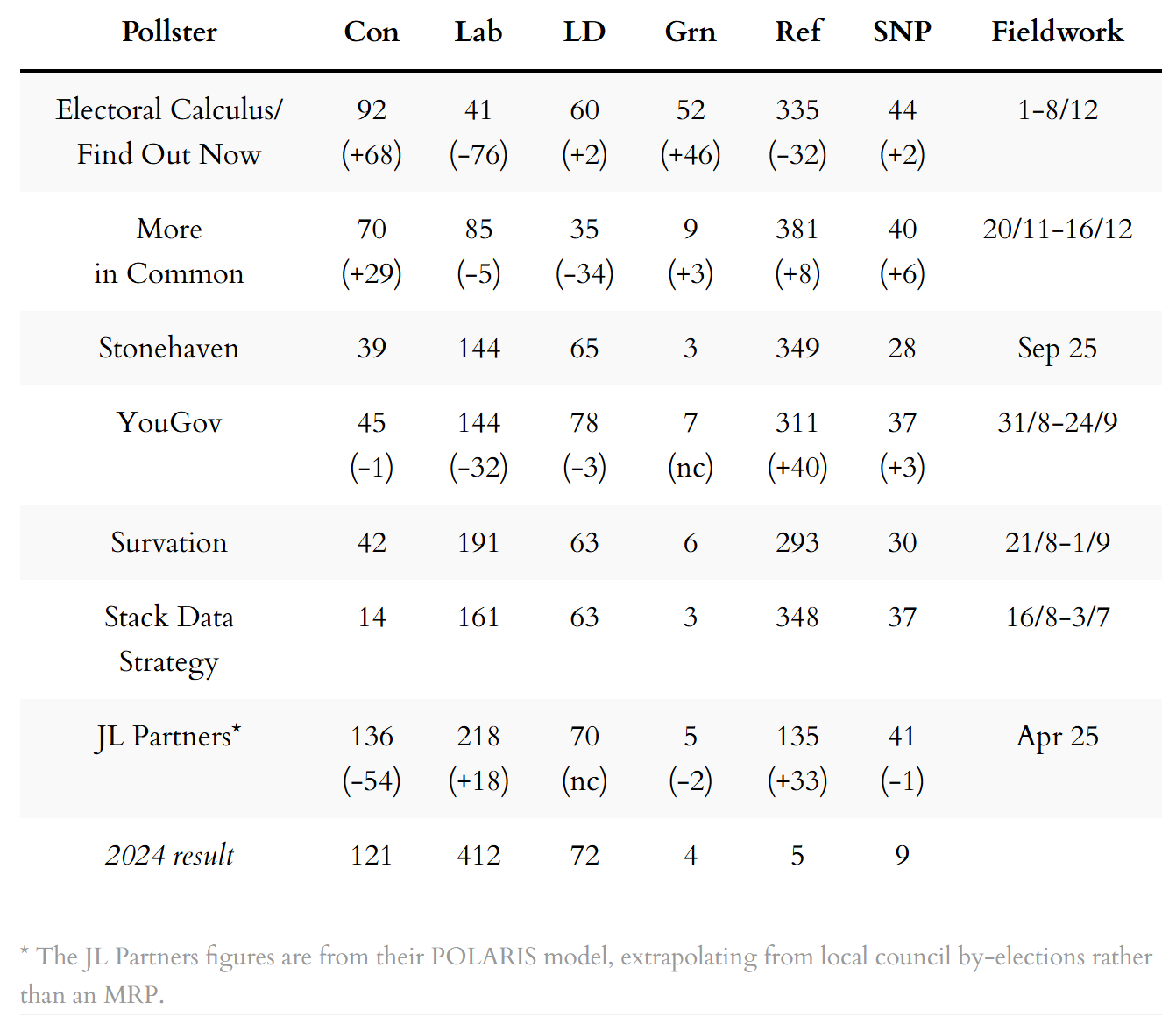
Next, the latest seat projections from MRPs and similar models, also sorted by fieldwork dates. As these are infrequent, note how old some of the ‘latest’ data is.
Finally, a summary of the latest leadership ratings, sorted by pollster name. Initial and long-term reactions to military events often turn out differently in the polls. But so far, the pair of polls from More in Common and Opinium suggests a bump in Keir Starmer’s ratings following the US and Israeli military action against Iran.

The table is also online here with additional details, and is updated regularly through the week as new data comes out.
For the historic figures for both voting intention and leader approval, including Parliamentary by-election polls, see PollBase.
Catch up on the previous two editions


My privacy policy and other legal information are available here. Links to purchase books or other items are usually affiliate links which pay a commission for each sale.
Quotes from social media messages are occasionally edited lightly for punctuation and clarity.
If you are subscribed to other email lists of mine, please note that unsubscribing from this one will not automatically remove you from the others. If you wish to be removed from all my lists, simply reply to this email to let me know.
A striking poll result for both Reform and the Lib Dems, and 9 other polling insights you shouldn’t miss
The following 10 findings from the most recent polls and analysis are only for subscribers who pay for the full edition, but you can sign up for a free trial to read them straight away.
More in Common periodically asks people which party they would vote against if they had to pick one. The question’s novelty means we can’t reliably predict future tactical voting patterns from it, but it is certainly suggestive of what might happen. Which is why the latest figures are striking, particularly for both Reform and the Liberal Democrats:
